
A traditional factory can manufacture your garments efficiently. However, its role usually begins with a production brief and ends when the finished order is delivered.
For an established fashion business with internal teams managing design, branding, marketing, e-commerce and logistics, that focused production model may be sufficient.
A fashion startup, emerging label or boutique brand often needs more.
Manufacturing is only one part of building a commercially viable fashion business. Founders must also develop the collection, establish a clear identity, prepare campaign content, select sales channels, organise logistics and create a realistic route to market.
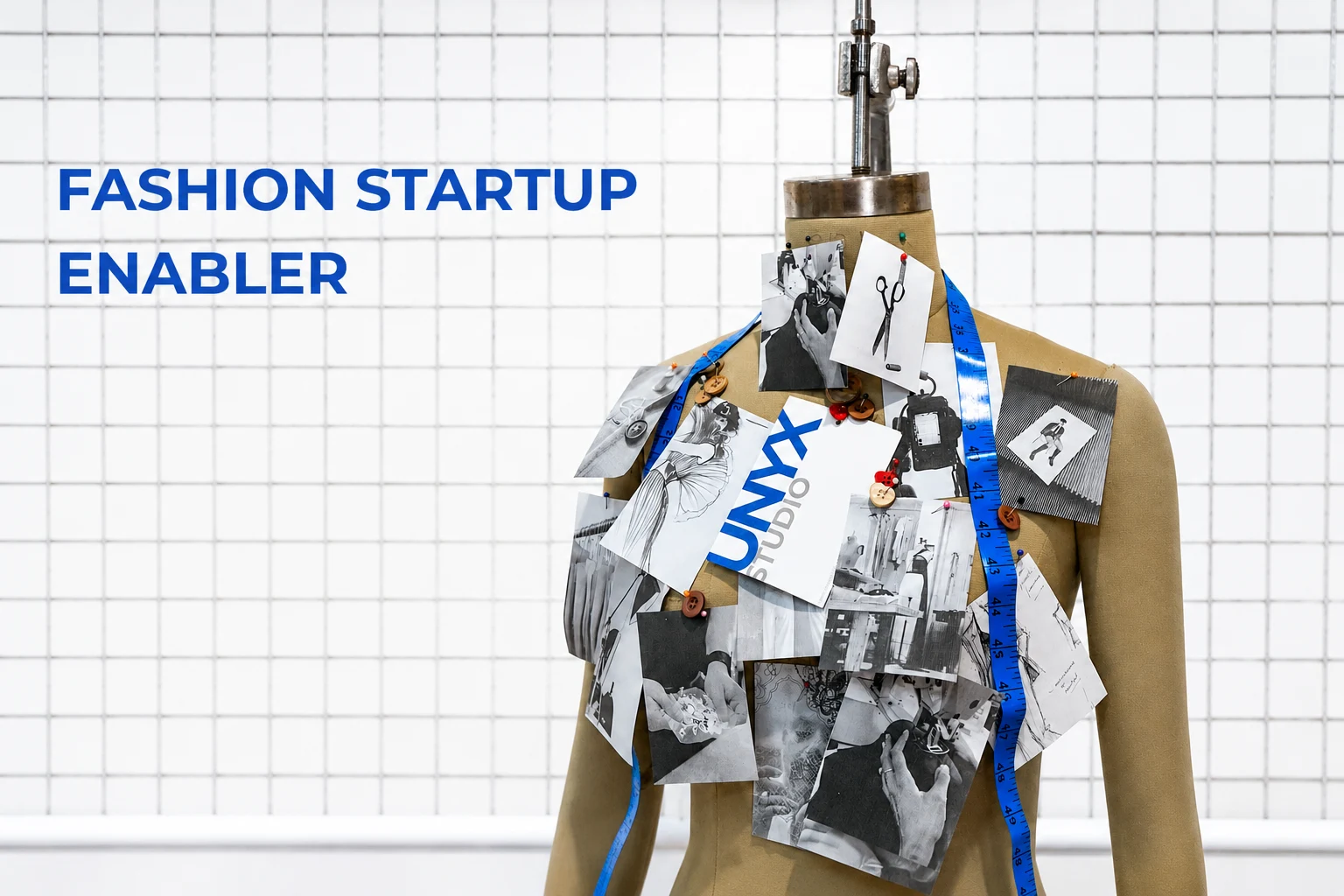
This is the difference between working with a conventional factory and partnering with UNYX STUDIO as a Fashion Startup Enabler.
UNYX STUDIO does not operate as a traditional manufacturer or sourcing agency. We bring together design, manufacturing and marketing support to help fashion startups and emerging brands build, launch and scale their businesses.
What A Traditional Factory Actually Offers
A conventional garment factory is generally structured to provide:
- Production capacity at an agreed minimum order quantity
- Sampling and product development within its available capabilities
- Material sourcing through its supplier network
- Manufacturing according to approved specifications
- Quality-control procedures based on agreed production standards
- Packing and shipment of the completed order
These are essential services, and experienced factories can perform them effectively.
However, the factory may not be responsible for the brand’s positioning, campaign development, website, marketplace readiness, launch strategy or post-production growth.
That does not make the factory model inadequate. It means its scope is narrower.
For larger brands with dedicated internal departments, that separation may work well. For startups operating with small teams, limited capital and little production experience, it can create major coordination gaps.
Where The Gap Becomes A Problem
The limitations of a production-only model often become visible after manufacturing is complete.
A founder may receive the finished inventory and then realise that:
- Campaign content is still being planned
- The website is not ready for orders
- Product descriptions and marketplace listings are incomplete
- Packaging does not fully reflect the brand identity
- PR and influencer outreach have not started
- Warehousing and fulfilment systems remain unresolved
- The launch date no longer matches the original commercial window
The factory may have completed its responsibility successfully. The problem is that the rest of the business was not developed at the same pace.
This is why manufacturing should be treated as one stage within a wider launch system rather than the final objective.
A Fashion Startup Enabler coordinates product development with the creative, commercial and operational work required to bring the collection to market.
What Does A Fashion Startup Enabler Do Differently?
The difference isn’t just about offering more services. It’s about how those services connect.
When manufacturing, branding, content, and go-to-market planning happen inside the same team, they talk to each other. The campaign shoot is planned around the production timeline. The brand identity is built before the packaging gets printed. The marketplace listings go live when the inventory lands, not three weeks after.
Here’s what that looks like in practice compared to a traditional factory setup:
Traditional factory:
- Takes the brief, produces the garment, ships the order
- No involvement in brand strategy or creative direction
- High MOQs that tie up capital in inventory
- No support post-delivery
Fashion startup enabler:
- Starts with the brand strategy before sampling begins
- Manages production alongside creative, content, and marketing timelines
- Works with emerging brands at realistic volumes
- Stays involved through market entry and beyond
The practical effect is that a brand working with an enabler arrives at launch day with everything ready. Not just the product.
The MOQ Problem Nobody Talks About Enough
Traditional factories need volume to justify their setup costs. That’s legitimate. But it creates a real problem for boutique and startup brands who are still validating their market.
A brand forced into a 500-piece MOQ on a first production run is carrying significant inventory risk. If the collection doesn’t move at the expected rate, that capital is locked in stock instead of going toward the next season, a new category, or marketing spend that would actually help sell what’s already there.
A fashion startup enabler structures production around the brand’s actual stage. Smaller initial runs with room to scale as demand is confirmed. That’s not a compromise, it’s the right approach for a brand that hasn’t yet built predictable demand.
Strategy Is Not Something Factories Provide
A traditional factory manufactures according to the information and specifications it receives.
It may provide technical recommendations relating to construction, materials or production feasibility, but it is not normally responsible for evaluating the wider business model.
Questions such as the following usually sit outside a factory’s production scope:
- Is the collection too broad for a first launch?
- Does the intended retail price support the production cost?
- Is the brand positioned clearly enough?
- Does the launch date suit the target market?
- Are the content and sales channels ready?
- Can the fulfilment system handle expected demand?
A Fashion Startup Enabler considers these questions because production decisions affect the wider success of the business.
At UNYX STUDIO, we support founders across collection design, product development, manufacturing, brand identity, campaign content, marketing and market-entry planning.
Our objective is not simply to complete an order. It is to help the founder build a fashion business that is prepared to enter the market and grow beyond its first collection.
Build A Business, Not Just A Production Order
A traditional factory can be the right choice for a company that already has experienced teams managing every other part of the fashion business.
A startup or emerging brand may need a more connected model.
UNYX STUDIO operates as a Fashion Startup Enabler, helping founders coordinate the full journey from an early concept to a market-ready and scalable fashion business.
Our support can include:
- Fashion consultation
- Collection design
- Tech packs and technical development
- Material sourcing
- Sampling
- Manufacturing
- Quality control
- Brand identity
- Campaign content
- Digital marketing
- E-commerce
- Marketplace preparation
- Logistics planning
With headquarters in Noida, India, regional offices in New York and Sydney, an owned SEDEX and OEKO-TEX compliant factory and a network of more than 100 trusted suppliers, we are structured to support fashion brands building for global markets.
The objective is not to replace the role of a capable factory. It is to connect manufacturing with every other function required to launch and grow the brand successfully.
Book a discovery call with UNYX STUDIO to discuss your collection, current operational gaps and growth plans, and explore how working with a Fashion Startup Enabler can help you build, launch and scale your business through one coordinated partnership.
FAQs
1. What is a fashion startup enabler?
A fashion startup enabler is a partner that supports emerging brands beyond manufacturing. Depending on the services offered, this may include product development, branding, content creation, marketing, e-commerce, marketplace onboarding, and logistics to help take a brand from concept to launch.
2. How is a fashion startup enabler different from a traditional garment factory?
A traditional factory primarily focuses on producing garments, whereas a fashion startup enabler often provides broader business support, helping brands with areas such as strategy, brand development, production management, and market entry alongside manufacturing.
3. Why are lower minimum order quantities (MOQs) important for fashion startups?
Lower MOQs allow new brands to test products with less upfront investment, reduce excess inventory, and respond more quickly to customer demand before scaling production.
4. Can a fashion startup enabler help after production is complete?
Yes. Many fashion startup enablers continue supporting brands after manufacturing by assisting with product launches, digital marketing, marketplace management, logistics, fulfilment, and ongoing business growth, depending on their service offering.
5. Who can benefit most from working with a fashion startup enabler?
Fashion startup enablers are particularly valuable for startups, emerging designers, and boutique fashion brands that need guidance across multiple stages of building and growing a fashion business, rather than manufacturing support alone.